
































































































































































How Exercise Affects Metabolism: 13 Practical Ways That Actually Matter
Author: RVLNSV PRASAD
Updated On: September 2026
About Us
Author Bio
Editorial Policy
Contact Us
Quick Answer
If you are wondering how exercise affects metabolism, the short answer is that exercise changes how much energy your body uses and can support muscle maintenance, physical fitness, and metabolic health. But exercise does not simply switch your metabolism into a permanently “faster” mode.
A workout increases energy expenditure while you are active, and some energy continues to be used during recovery. Resistance training can also help maintain or build muscle, which is relevant to resting energy expenditure. Meanwhile, regular physical activity can improve health outcomes even when body weight changes very little.
That is why it is more accurate to think of exercise as a tool for supporting metabolic health and total energy expenditure, rather than as a magic metabolism accelerator.
The CDC’s adult physical activity guidance recommends at least 150 minutes of moderate-intensity aerobic activity each week, together with muscle-strengthening activity on at least 2 days.
Key Takeaways
- Exercise increases the amount of energy your body uses.
- Exercise and metabolism are related, but metabolism is much more than calories burned during a workout.
- Strength training can help maintain muscle mass, particularly during weight loss.
- Walking and other everyday movement count toward physical activity.
- HIIT can be useful, but it is not the only exercise that matters for metabolism.
- A larger workout does not automatically produce proportionally larger weight loss.
- Some people compensate for exercise by eating more or moving less later.
- Improving metabolic health is a broader goal than simply trying to increase resting metabolism.
- Consistency usually matters more than finding a supposed “metabolism hack.”
- You can gain important health benefits from physical activity even when the scale changes slowly.
How Exercise Affects Metabolism
The phrase “boost your metabolism” makes metabolism sound like a machine with an on/off switch.
Real human metabolism is more complicated.
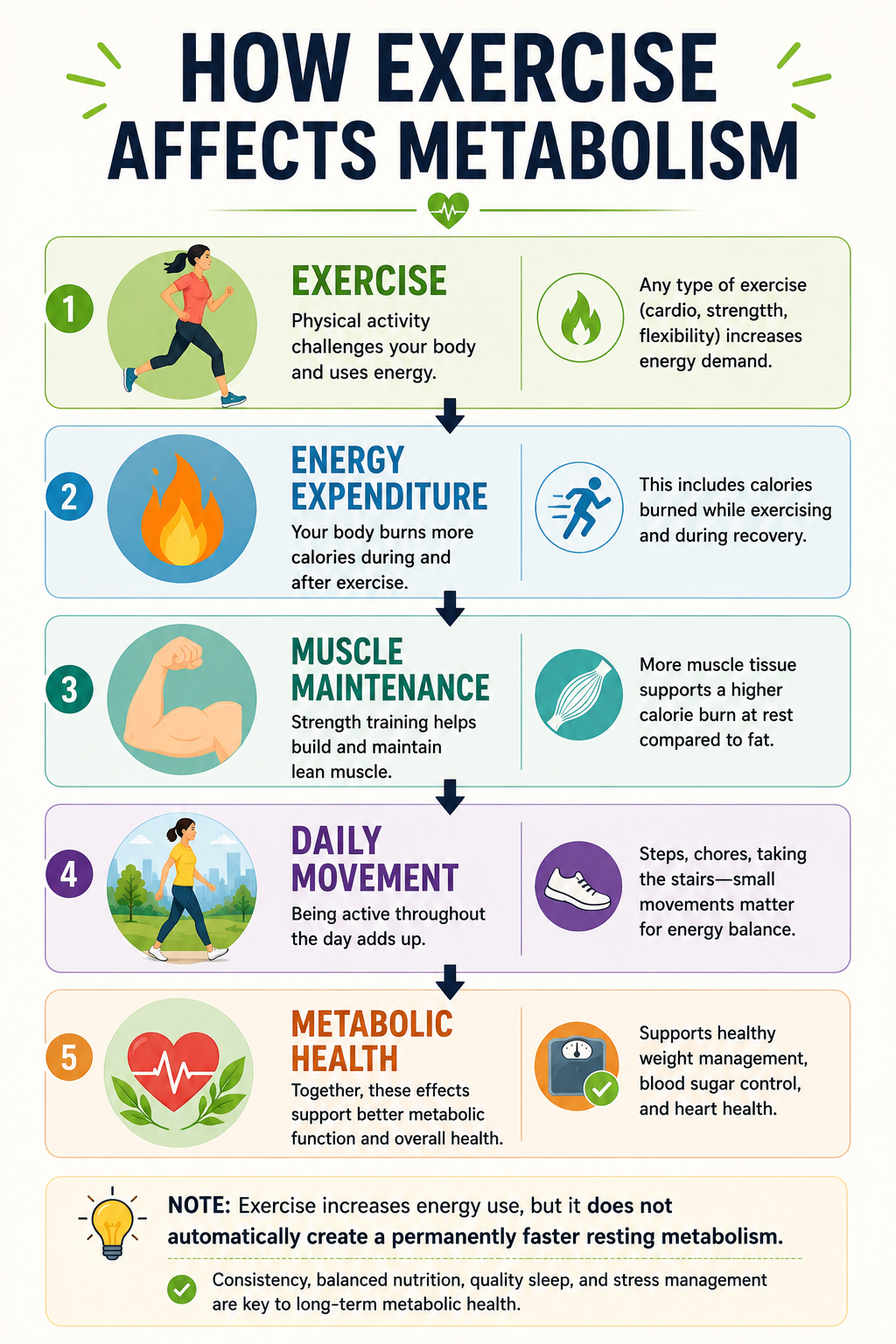
Your body is constantly using energy to keep your heart beating, maintain body temperature, support your brain, repair tissues, digest food, and perform physical activity. Exercise is only one part of this larger picture.
When you exercise, your muscles require more energy. Walking, cycling, swimming, resistance training, running, household activities, and other movement can therefore increase energy expenditure.
But there is an important distinction:
Burning more calories through activity is not the same thing as permanently increasing your resting metabolic rate.
That difference is often missing from popular fitness articles.
The National Institute of Diabetes and Digestive and Kidney Diseases (NIDDK) explains that body weight is influenced by several factors, including food and beverage intake, daily activity, sleep, medicines, health conditions, genes, and other factors.
So rather than asking only, “How can I make my metabolism faster?” a more useful question is:
How can I use exercise to increase useful movement, preserve muscle, improve fitness, and support long-term metabolic health?
That is the approach I take in this article.
My Personal Experience With Exercise and Metabolism
I spent many hours working at a desk for years.
Like many people who spend a lot of time sitting, I gradually noticed that I was becoming less active during the day. I often felt tired after long periods of work, and I realized that simply sitting for hours was becoming part of my routine.
I did not respond by immediately starting an extreme workout program.
Instead, I started with simple changes.
I walked regularly. I added some stretching. Later, I included light strength exercises that I could do consistently.
After several weeks, I personally noticed that I felt more energetic and physically active during the day.
That experience changed the way I thought about exercise.
I stopped looking for one dramatic exercise that would “speed up” my metabolism and started thinking more about regular movement.
There is an important distinction here.
My experience is personal observation, not scientific proof that my resting metabolic rate increased. I cannot measure my own metabolism accurately just by noticing that I feel more energetic.
However, my experience helped me understand something that research and public-health guidance also emphasize: regular movement has value beyond what happens on the weighing scale.
NIDDK notes that physical activity can provide important health benefits even when someone does not lose weight or maintain weight loss.
Understanding Metabolism Before You Try to Change It
Metabolism refers to the collection of chemical processes through which your body uses energy.
For everyday discussions, it helps to think about several components of energy expenditure.
Resting energy expenditure
This is the energy your body uses while at rest to maintain essential functions.
It represents a large portion of daily energy expenditure.
Physical activity
This includes both planned exercise and movement throughout the day.
Walking to work, climbing stairs, exercising, gardening, cleaning, and other activities all require energy.
Thermic effect of food
Your body also uses energy to digest, absorb, and process food.
Why this matters
If you exercise for 30 minutes, you are increasing energy expenditure through physical activity.
That does not automatically mean your resting metabolism will permanently increase by a large amount.
This distinction helps explain why how exercise affects metabolism is a more useful question than simply asking how to “speed up” metabolism.
13 Ways Exercise Can Support Metabolism and Metabolic Health
1. Increase Your Total Daily Movement
The first step does not need to be a complicated workout.
Simply becoming more physically active can increase the amount of energy you use throughout the day.
The World Health Organization emphasizes that physical activity includes movement during work, transportation, leisure, sport, and household activities—not just formal exercise.
That means your metabolic-health strategy can include:
- Walking
- Taking stairs
- Gardening
- Household chores
- Cycling
- Active commuting
- Playing with children
- Short movement breaks
This is especially useful for people who spend most of their working day sitting.
Instead of thinking:
“I need a perfect one-hour workout.”
Think:
“How can I move more throughout my entire day?”
That change can make physical activity feel much more achievable.
2. Walk Consistently
Walking is sometimes dismissed because it does not feel as intense as running or HIIT.
That is a mistake.
Walking is accessible, repeatable, and easy to incorporate into everyday life.
A brisk walk increases energy expenditure and contributes to your weekly physical activity total. NIDDK specifically identifies brisk walking as an example of moderate-intensity aerobic activity and recommends gradually building activity when necessary.
Walking may be particularly useful because many people can maintain it for months or years.
You could:
- Walk after meals
- Walk during work breaks
- Walk while talking on the phone
- Take stairs when practical
- Walk for transportation
- Add a short evening walk
The goal is not to make walking sound like a miraculous metabolism booster.
The goal is to make movement a normal part of your day.
3. Add Resistance Training
If you want to understand strength training and metabolism, start with muscle.
Resistance training challenges muscles through movements such as
- Squats
- Push-ups
- Rows
- Lunges
- Resistance-band exercises
- Weight training
Maintaining muscle is particularly important during periods of weight loss because losing body mass can include loss of lean tissue.
NIDDK recommends muscle-strengthening activities as part of an overall physical activity plan and notes that strength training may help maintain muscle mass and prevent muscle loss with aging or weight loss.
That makes resistance training valuable even if its effect on resting metabolism is smaller than many social media claims suggest.
The goal is not to build an enormous amount of muscle.
It is to maintain and develop useful strength and lean tissue over time.
4. Protect Muscle During Weight Loss
This is one of the most important points that gets lost in the “boost metabolism” conversation.
When someone loses weight, the body does not necessarily lose only fat.
Changes in lean tissue can also occur.
That is one reason resistance exercise deserves a place in a sensible weight-management plan.
Instead of asking:
“Which exercise burns the most calories?”
A better question can be:
“Which combination of activities helps me become fitter while maintaining as much useful muscle as possible?”
This is a much more sustainable approach.
Regular physical activity combined with appropriate nutrition can support weight management, while strength training provides an important stimulus for muscles. NIDDK also recommends muscle-strengthening activity at least twice a week for adults.
5. Progress Strength Training Gradually
Doing the same resistance exercise forever is not necessarily the best way to continue improving.
Your body adapts to training.
You can gradually increase difficulty by changing:
- Resistance
- Repetitions
- Sets
- Exercise variation
- Range of motion
- Control and technique
You do not need to increase everything at once.
For a beginner, even learning to perform basic movements consistently can be meaningful progress.
The Physical Activity Guidelines for Americans recommend gradually increasing muscle-strengthening activity rather than beginning with an unnecessarily demanding program.
The practical lesson is simple:
Progress slowly enough that you can keep going.
6. Use Aerobic Exercise to Increase Energy Expenditure
Running, cycling, swimming, brisk walking, dancing, and similar activities can increase energy expenditure while improving cardiorespiratory fitness.
Aerobic exercise is not valuable only because of calories burned.
Regular physical activity has broader health effects.
The WHO states that regular physical activity benefits cardiovascular, metabolic, mental, and overall health.
For many adults, a practical starting point is moderate-intensity activity that makes breathing and heart rate increase without making the activity feel overwhelming.
- You do not need to run if you dislike running.
- You can choose cycling.
- You can walk briskly.
- You can swim.
- You can dance.
The best option is often the one you can repeat.
7. Use HIIT Strategically—Not as a Magic Trick
High-intensity interval training, or HIIT, alternates periods of harder effort with recovery.
It can be time-efficient and can improve fitness.
But HIIT has developed an exaggerated reputation as a special metabolic shortcut.
It is not necessary for everyone.
A beginner who struggles to walk for 20 minutes does not need to start with repeated maximal intervals simply because an online article promises an “afterburn.”
Exercise intensity should match your fitness, experience, recovery ability, and preferences.
If HIIT is appropriate for you, it can be one useful tool.
If you prefer brisk walking, cycling, swimming, or conventional strength training, those activities can also contribute meaningfully to health and energy expenditure.
The broader guidelines do not require HIIT specifically. Adults can meet aerobic activity recommendations through moderate activity, vigorous activity, or an equivalent combination.
8. Break Up Long Periods of Sitting
This is an area where the phrase “exercise for metabolism” can become misleading.
Someone might complete a 30-minute workout and then spend another nine hours sitting.
That workout still has value, but it does not erase the rest of the day’s inactivity.
The CDC’s guidance emphasizes:
Move more and sit less.
Even some activity is better than none.
Try simple movement breaks:
- Stand during phone calls
- Walk around your workplace
- Stretch between tasks
- Walk to another room instead of sending a message
- Take a short walk during a break
You do not need to turn every break into a workout.
The objective is to interrupt prolonged inactivity and make movement part of normal life.
9. Increase Non-Exercise Movement
Not all physical activity happens in the gym.
The scientific literature sometimes uses terms such as NEAT, or non-exercise activity thermogenesis, to describe energy expenditure from everyday movement that is not planned exercise.
This can include standing, walking around, household tasks, and other physical activities.
Research suggests that some people may reduce non-exercise activity after starting an exercise program, although the magnitude and consistency of this compensation vary.
This is an important practical lesson.
If you start exercising but become so tired that you spend the rest of the day lying down, your overall activity pattern may not change as much as you expected.
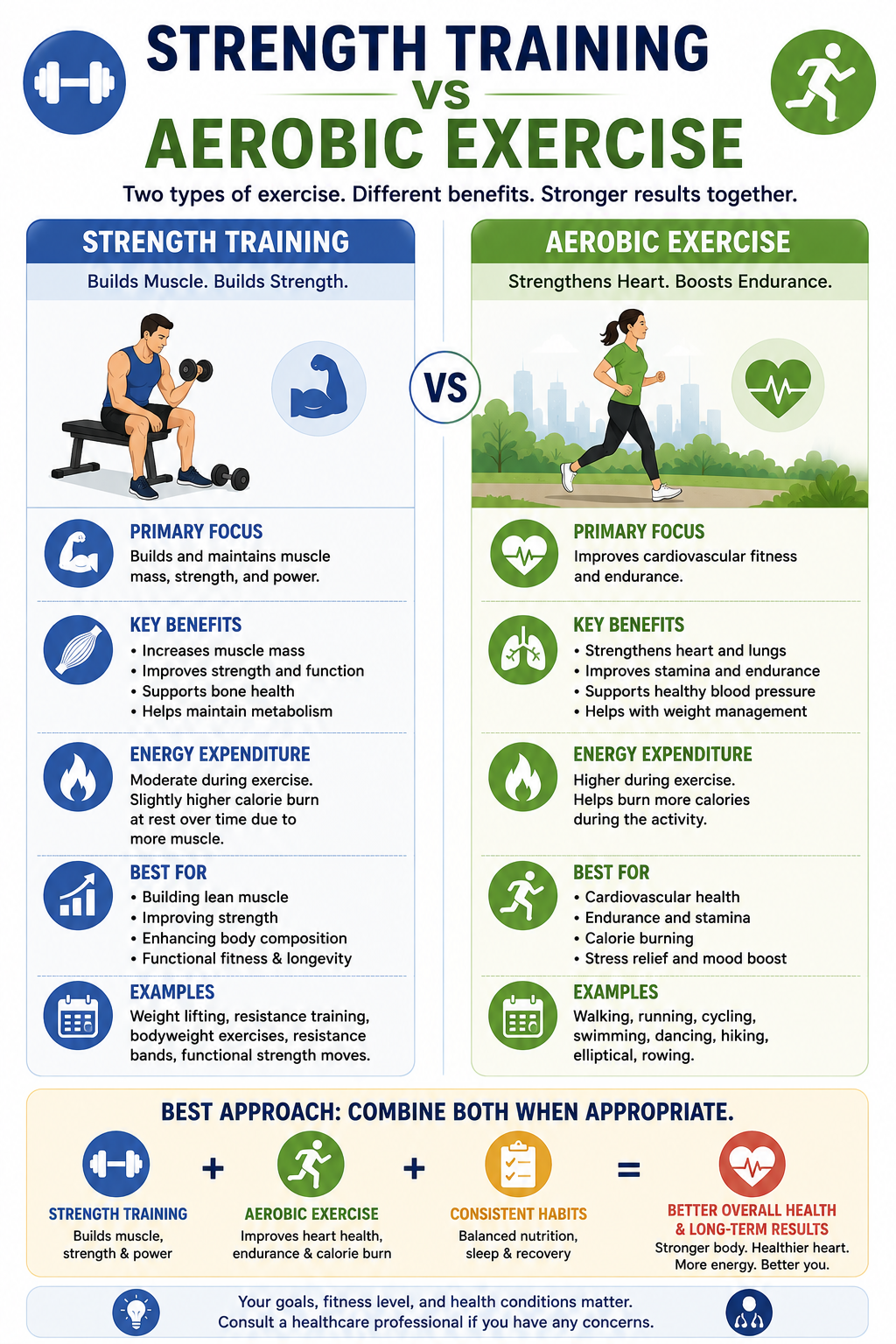
10. Combine Strength and Aerobic Exercise
You do not have to choose between strength training and cardio.
They serve different purposes.
Strength training can help you:
- Build or maintain muscle
- Improve strength
- Support bone health
- Improve physical function
Aerobic activity can help you:
- Improve cardiorespiratory fitness
- Increase energy expenditure
- Support cardiovascular health
- Make sustained movement easier
A combined approach can therefore be more useful than obsessing over which single exercise “boosts metabolism” the most.
Current adult activity guidelines recommend both aerobic activity and muscle-strengthening activity.
A better goal is
Exercise regularly while continuing to live an active daily life.
11. Choose an Exercise Intensity You Can Recover From
Harder is not automatically better.
If every workout leaves you exhausted, sore, or unable to perform your normal activities, the program may be too demanding.
Recovery matters because exercise is a repeated behavior.
Think about:
- Your current fitness
- Your age and physical abilities
- Your work schedule
- Sleep
- Previous injuries
- Recovery between sessions
- Enjoyment
Someone who walks regularly for years may ultimately accumulate far more useful physical activity than someone who repeatedly starts extreme workout programs and quits.
NIDDK recommends starting slowly when necessary, choosing activities you enjoy, and gradually adding more activity.
12. Focus on Consistency Rather Than Metabolic “Hacks”
The internet is full of claims about exercises that supposedly “ignite,” “reset,” or “supercharge” metabolism.
These phrases can make ordinary exercise sound ineffective.
It isn’t.
The more useful question is:
Can I perform this activity regularly?
A realistic exercise routine might look surprisingly ordinary:
- Regular walking
- Two strength sessions each week
- Some aerobic activity
- Movement breaks during work
- Active hobbies
- Adequate recovery
The WHO physical activity guidelines recommend at least 150–300 minutes of moderate-intensity aerobic activity per week for adults, or 75–150 minutes of vigorous activity, together with muscle-strengthening activity on at least 2 days per week.
You do not need a secret exercise.
You need a routine you can maintain.
13. Think About Metabolic Health, Not Just a “Fast Metabolism”
This may be the most important change in perspective.
Metabolic health includes much more than how many calories you burn while sitting.
Physical activity can influence important health measures and is associated with benefits involving cardiovascular health, glucose regulation, physical function, and other aspects of health.
For example, systematic-review evidence has found improvements in insulin sensitivity following exercise interventions in healthy adults, while research in people with type 2 diabetes has also demonstrated benefits from regular exercise.
That means you can make meaningful health progress even if your body weight does not change dramatically.
NIDDK similarly notes that physical activity can provide important health benefits independent of whether someone loses weight.
That is a much more useful definition of success than simply trying to “burn more calories.”
Does Exercise Increase Metabolism?
Sometimes—but the answer depends on what you mean by metabolism.
Exercise clearly increases energy expenditure during physical activity.
There can also be additional energy expenditure during recovery.
Resistance training may help support muscle mass, which is relevant because metabolically active tissue contributes to resting energy expenditure.
But that does not mean a workout permanently transforms a person’s resting metabolic rate.
This is why headlines promising that one workout will “supercharge your metabolism all day” should be treated cautiously.
The practical benefit of exercise is broader:
more movement, better fitness, muscle support, improved metabolic health + sustainable habits.
The Exercise Compensation Problem
Here is something many weight-loss articles fail to explain.
Suppose a smartwatch says that your workout burned 400 calories.
It is tempting to assume:
“I burned 400 extra calories, so I should lose exactly the amount of weight associated with 400 calories.”
Real life is more complicated.
After exercise, a person might:
- Feel hungrier
- Eat a little more
- Move less later
- Rest more because of fatigue
- Reduce other physical activity
These responses do not happen to everyone, and they vary considerably.
But research has documented compensation in some exercise interventions. A systematic review found that weight loss from exercise can be less than expected, while another review found evidence that some people reduce non-exercise physical activity after beginning structured exercise.
This does not mean exercise is ineffective.
It means calorie mathematics should not be treated as a perfect prediction of individual weight change.
That is one reason I prefer to judge exercise by several outcomes:
- Fitness
- Strength
- Daily activity
- Waist measurement
- Physical function
- Health markers
- Energy and well-being
- Long-term weight trends
The scale is only one measurement.
Strength Training vs Cardio: Which Is Better for Metabolism?
There is no single winner.
| Activity | Main value | Metabolism-related relevance |
|---|---|---|
| Walking | Accessible daily movement | Increases energy expenditure |
| Brisk walking | Aerobic activity | Supports energy expenditure and fitness |
| Running | Vigorous aerobic activity | Higher exercise energy expenditure |
| Cycling | Aerobic fitness | Supports cardiovascular fitness and energy use |
| Swimming | Full-body aerobic activity | Useful for fitness and movement |
| Strength training | Muscle and strength | Helps maintain/build lean tissue |
| HIIT | Time-efficient vigorous activity | Increases exercise intensity and fitness |
| Daily movement | Reduces inactivity | Adds activity outside workouts |
The key is not to find a magical metabolism exercise.
The key is to create a balanced activity pattern.
How Much Exercise Do You Need?
For general adult health, current guidance recommends:
- 150–300 minutes of moderate-intensity aerobic activity per week, or
- 75–150 minutes of vigorous-intensity activity per week, or an equivalent combination
- Muscle-strengthening activities on at least 2 days per week
These recommendations come from major public health authorities, including WHO and the CDC.
You do not have to reach the full target immediately.
If you have been inactive, start with an amount you can manage and gradually increase it.
NIDDK notes that even short periods of activity can be useful when building toward a regular routine.
A Simple Weekly Exercise Framework
Here is an example of how a generally healthy adult might organize activity.
Monday
Brisk walking + short strength session
Tuesday
Walking or another enjoyable aerobic activity
Wednesday
Movement breaks + easy walking
Thursday
Strength training + short walk
Friday
Moderate aerobic activity
Saturday
Longer walk, cycling, swimming, or another enjoyable activity
Sunday
Recovery and light movement
This is an example framework, not a personalized medical exercise prescription.
Your schedule can be adjusted according to your fitness, health, work, preferences, and recovery needs.
The important principle is to combine different forms of movement rather than chase one supposed metabolic shortcut.
Common Metabolism Exercise Myths
Myth 1: Exercise permanently speeds up metabolism.
Reality: Exercise increases energy expenditure and can support muscle and metabolic health, but it should not be described as permanently turning up resting metabolism.
Myth 2: HIIT is the only exercise that boosts metabolism.
Reality: HIIT is one training option. Walking, aerobic exercise, resistance training, and everyday movement can all contribute to physical activity and health.
Myth 3: You need to sweat heavily to improve metabolism
Reality: Sweating is primarily a cooling mechanism. It does not provide a simple measurement of how much your metabolism has improved.
Myth 4: More exercise always means more weight loss
Reality: Exercise can support weight management, but appetite, food intake, daily movement, genetics, sleep, and other factors can influence the final result.
Myth 5: Muscle makes you burn huge amounts of extra calories.
Reality: Muscle contributes to resting energy expenditure, but online claims often exaggerate the size of the effect.
The value of strength training extends beyond resting calorie burn.
Myth 6: Walking is too easy to matter
Reality: Walking can contribute to total physical activity, energy expenditure, cardiovascular fitness, and a more active lifestyle. WHO specifically counts walking and everyday movement as physical activity.
Myth 7: If you exercise, diet does not matter.
Reality: Exercise and eating habits affect different parts of weight management and health. NIDDK describes healthy eating and physical activity together as important components of weight management.
How to Start If You Have Been Inactive
If you have spent months or years being inactive, don’t make your first week a test of willpower.
Start smaller.
You could begin with:
- 5–10 minute walks
- Gentle mobility exercises
- Simple bodyweight movements
- Short movement breaks
- Gradually increasing walking time
- Light resistance exercises
Then build gradually.
The NIDDK guide to getting active recommends starting slowly, adding activity gradually, choosing activities you enjoy, and addressing barriers that make exercise difficult.
If you have a health condition, injury, significant symptoms, or concerns about starting exercise, speak with an appropriate health professional about what is safe for you.
What Exercise Cannot Do
Exercise is powerful, but it has limits.
It cannot guarantee:
- A permanently faster metabolism
- Dramatic weight loss
- Spot reduction of belly fat
- Unlimited calorie burning
- Freedom to ignore nutrition
- Protection against every metabolic disorder
This is not a criticism of exercise.
It is actually a reason to value exercise more realistically.
You do not need exercise to perform a miracle.
You need it to perform a useful job consistently.
My Realistic Approach to Exercise and Metabolism
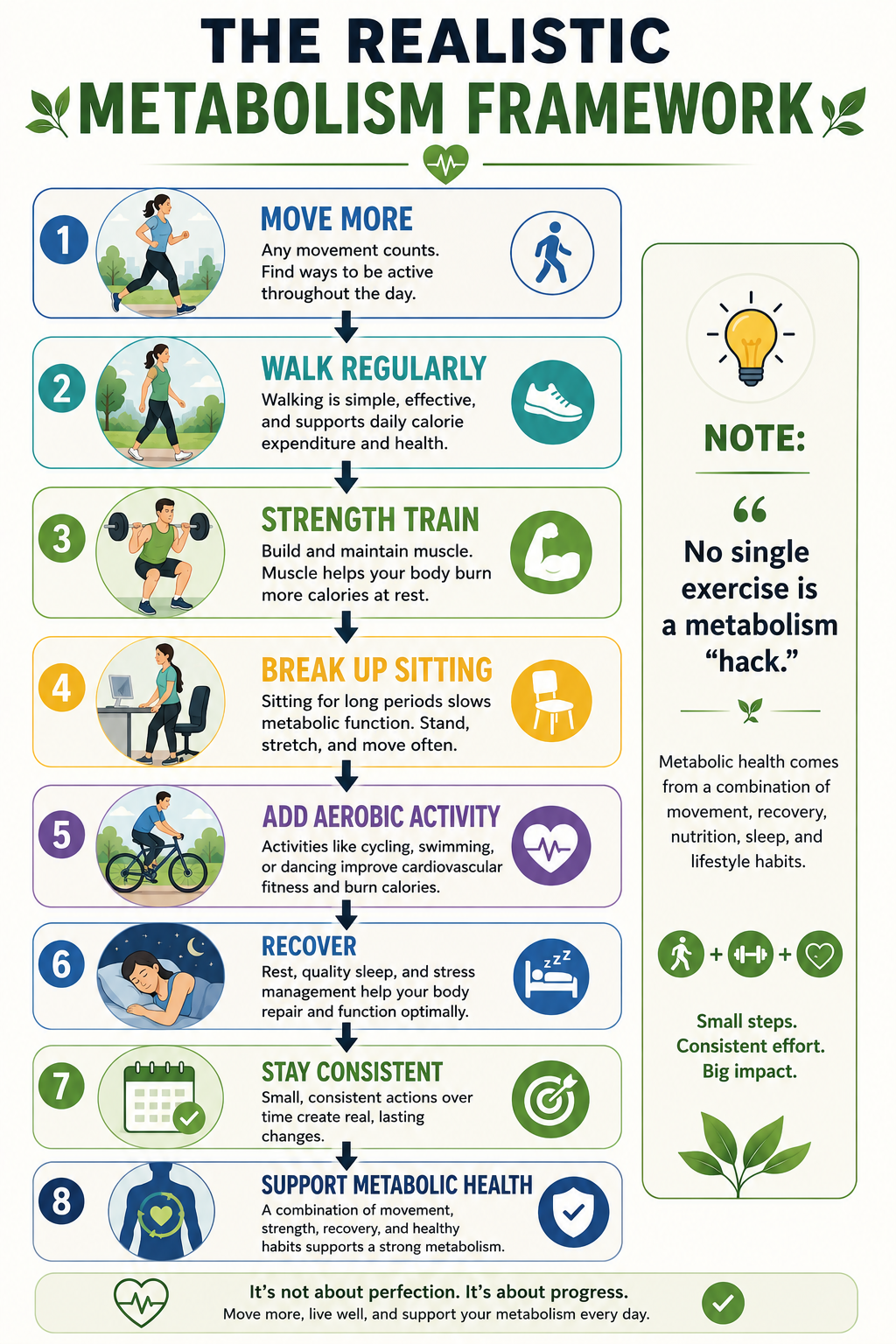
After my own experience of spending too much time sitting, I no longer think about metabolism as something that needs to be “hacked.”
I think about movement.
- If I sit for a long time, I try to move.
- If I can walk, I walk.
- If I can include strength exercises, I include them.
- If I have a busy day, I look for smaller opportunities instead of deciding that the whole day is lost.
That mindset is much easier to maintain than chasing an extreme workout.
And I think that is an important lesson for anyone searching for how exercise affects metabolism.
The goal isn’t to find the most dramatic workout.
The goal is to build an active life.
Frequently Asked Questions
1. How does exercise affect metabolism?
Exercise increases energy expenditure during activity and can support muscle maintenance, physical fitness, and metabolic health. It does not necessarily cause a large permanent increase in resting metabolic rate.
2. Does exercise increase metabolism?
Exercise increases energy use during the activity and can have effects during recovery. Resistance training may also support muscle mass. However, “increasing metabolism” should not be interpreted as permanently making your body burn dramatically more calories at rest.
3. What exercise is best for metabolism?
There is no single best metabolism exercise. A combination of aerobic activity, resistance training, and regular daily movement is a more useful approach.
4. Does strength training increase metabolism?
Strength training can help build or maintain muscle, which contributes to resting energy expenditure. Its benefits also include greater strength, physical function, and support for maintaining lean mass.
5. Does walking affect metabolism?
Walking increases physical activity and energy expenditure. Its biggest practical advantage is that many people can perform it regularly and incorporate it into daily life.
6. Does HIIT increase metabolism?
HIIT increases energy expenditure during vigorous exercise and can improve cardiorespiratory fitness. It is useful for some people but is not essential for everyone.
7. How long does exercise affect metabolism after a workout?
Energy expenditure can remain elevated during recovery, but the size and duration of this effect vary according to the exercise performed and the individual. It should not be treated as a huge source of additional calorie burning.
8. Can exercise improve metabolic health without weight loss?
Yes. Physical activity provides health benefits that are not dependent entirely on weight loss. NIDDK notes that people can experience important benefits from physical activity even when they do not lose weight.
9. How much exercise should adults get each week?
Current guidance recommends at least 150–300 minutes of moderate aerobic activity or 75–150 minutes of vigorous activity per week, plus muscle-strengthening activity on at least 2 days for adults.
10. Can exercise alone guarantee weight loss?
No. Weight change depends on multiple factors, including food intake, activity, daily living, sleep, health conditions, medicines, genetics, and other influences.
Final Thoughts
Understanding how exercise affects metabolism can change the way you approach fitness.
You do not need to search endlessly for the exercise that supposedly “supercharges” metabolism.
Instead, focus on the things exercise can realistically do:
Move more.
Use your muscles.
Improve fitness.
Reduce prolonged inactivity.
Support metabolic health.
Build habits you can repeat.
Exercise may contribute to weight management, but its value goes far beyond the number of calories shown on a fitness tracker.
For me, the biggest lesson was simple: I did not need an extreme workout to become more active. I needed to stop treating movement as something that happened only during a formal exercise session.
Walking, strength training, everyday movement, and consistency became more useful than chasing a quick metabolic fix.
That is the approach I believe is more realistic for long-term health.
Author Note
RVLNSV PRASAD writes health and wellness content with an emphasis on practical lifestyle strategies and evidence-based information.
The personal experience in this article reflects my own observations and is included to provide a real-world perspective. Personal experience should not be interpreted as scientific evidence or as a guarantee that exercise will produce the same results for every reader.
Medical Disclaimer
This article is intended for general educational purposes and does not replace individualized medical advice, diagnosis, or treatment. Exercise needs vary according to age, fitness level, injuries, medications, and health conditions. If you have a medical condition, significant symptoms, or concerns about beginning a new exercise program, consult a qualified healthcare professional.
Sources
- CDC — Adult Activity: An Overview
- WHO — Physical Activity
- NIDDK — Factors Affecting Weight & Health
- NIDDK — Staying Active at Any Size
- NIDDK — Tips to Help You Get Active
- NIDDK — Health Tips for Adults
- Physical Activity Guidelines for Americans
- PubMed — Exercise and Energy Compensation Systematic Review
- PubMed — Exercise and Non-Exercise Activity Compensation Review
- PubMed — Exercise and Insulin Sensitivity Meta-analysis
You Also Read
- 10 Best Exercises to Lose Belly Fat
- 7 Strength Training Exercises for Women Over 40: A Comprehensive Guide
- 8 Metabolic Mastery: Unlocking the Secrets to Sustainable Weight Loss







[…] 13 Best Ways To Boost Metabolism With Exercise […]
[…] 13 Best Ways To Boost Metabolism With Exercise […]
[…] 13 Best Ways To Boost Metabolism With Exercise […]